
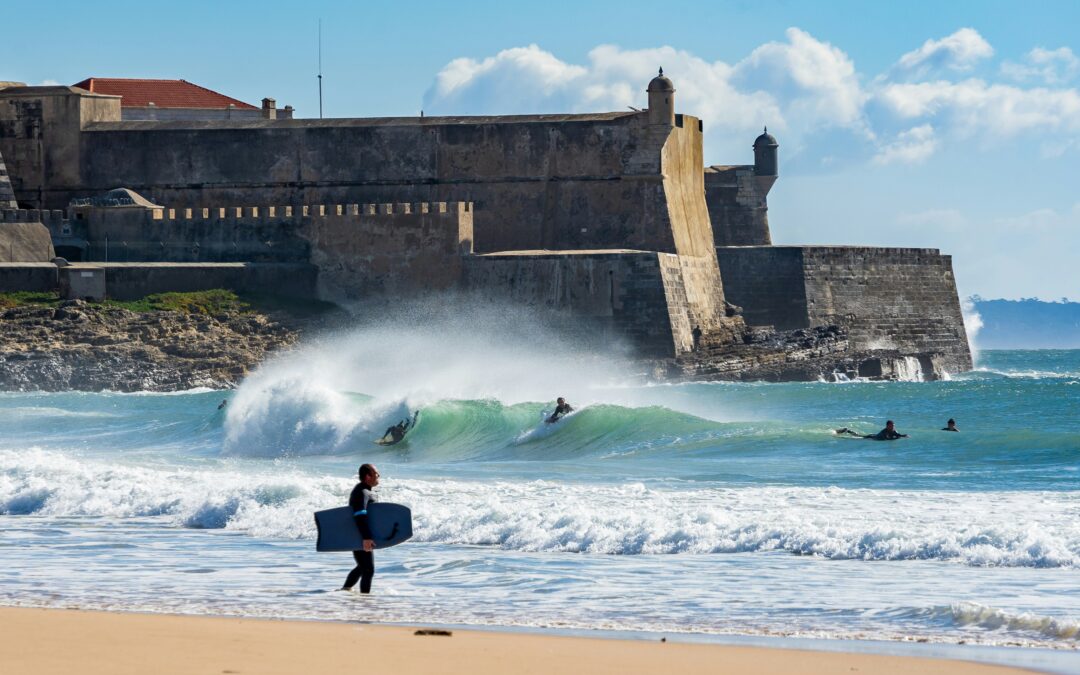
There are a few universal truths in travel. One: if you say “no worries” with enough confidence, people assume you know what you’re doing. Two: if you’re Australian, overseas, and within 200 metres of the ocean, you will be assumed to surf. Properly. Competently. Possibly for money.
Portugal is where these two truths combined to nearly end me.
I’d been in Ericeira for all of three days. Three. I’d eaten too many pastéis de nata, learned how to say obrigado with a passable accent, and purchased a pair of boardshorts that screamed “midlife surf dad” despite the fact I am neither midlife nor a surf dad. I was, by my own honest assessment, a casual surfer. Weekend warrior. A man whose relationship with the ocean is respectful but distant, like an uncle who sends birthday cards but never babysits.
But Ericeira doesn’t care about nuance. It’s Europe’s only World Surfing Reserve, a fact proudly repeated on plaques, menus, and possibly tattooed on at least one local’s calf. According to the World Surfing Reserves organisation, the coastline here hosts a unique concentration of reef breaks and point breaks, making it one of the most consistent surf regions on the continent. This is not a place for dabblers.
And yet, there I was.
It started innocently enough. I was waxing a rented shortboard on the beach—purely for aesthetics, mind you, because the board already had enough wax on it to immobilise a small mammal—when a bloke with dreadlocks and the relaxed authority of someone who has never had a real job wandered over.
“Australian?” he asked.
I nodded. Rookie error.
He smiled. “Ah. Good surfers.”
This is where I should’ve corrected him. Explained that Australians, like any people, exist on a spectrum. That for every Mick Fanning there are thousands of us who panic in overhead swell and bail at the first sign of a set wave. But instead, fuelled by ego and the lingering confidence of someone on holiday, I said the two words that would seal my fate.
“Yeah, mate.”
From there, the myth grew legs. Locals nodded at me in the lineup. A café owner asked if I’d “come for the winter swells.” Someone else asked what I thought of the break at Ribeira d’Ilhas, as if my opinion mattered. According to Surfline, Ribeira d’Ilhas is a high-performance right-hand point break that demands experience, positioning, and respect for fast-moving sections. I had Googled it once and decided it looked “busy.”
The final escalation came that afternoon, over a beer I absolutely did not need.
There was a small local surf competition happening the next day. Friendly. Community-based. Winner gets bragging rights and, allegedly, a meal tab at a beachside restaurant. I was informed—informed, not asked—that I should enter. “Good for the vibe,” they said. “Australians bring good energy.”
I laughed. They laughed. Everyone laughed.
But no one clarified that I was joking.
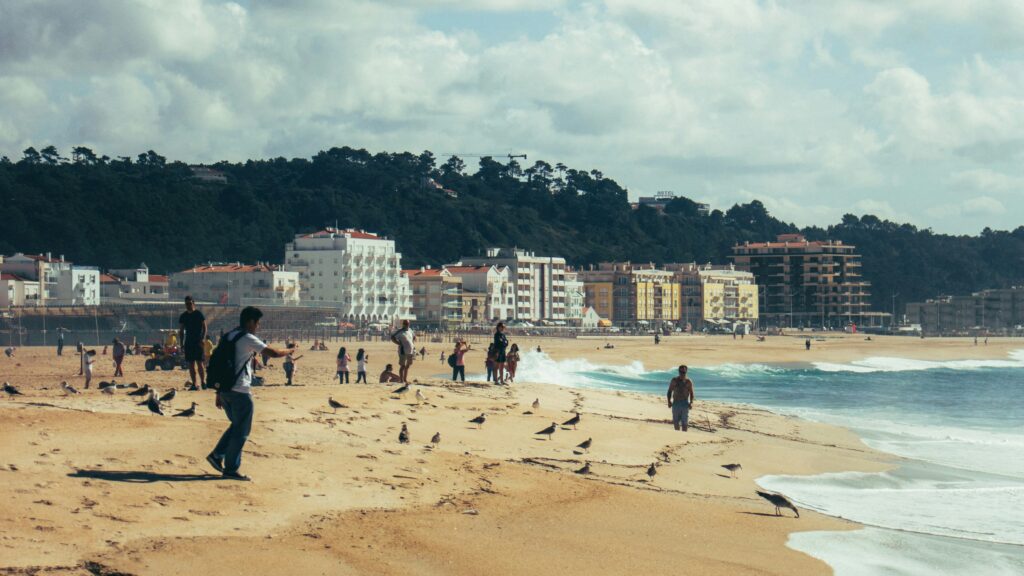
By sunset, my name—first name only, because that somehow made it more legit—was on a handwritten competitors list. I went to bed that night staring at the ceiling, listening to the Atlantic crash against the cliffs, my brain cycling through the five stages of impostor syndrome: denial, rationalisation, overconfidence, panic, and Googling “how to fake injury surfing.”
The morning of the comp dawned crisp and blue. Surfers gathered with quiet intensity, stretching, waxing boards with ritualistic focus. I stood among them like a bloke who’d wandered onto a construction site wearing thongs. The ocean looked… energetic. The kind of energetic that National Geographic documentaries describe with phrases like “unforgiving” and “powerful forces of nature.”
When my heat was called, I paddled out trying to project calm. This was a mistake, as calm paddling is suspicious. Real surfers paddle with purpose. I drifted into the lineup, immediately in the way, apologising to at least three people in under a minute. One of them clapped me on the shoulder and said, “Relax, Aussie. You’ve got this.”
Reader, I did not have this.
The horn blew. A set approached. Everyone spun and paddled with terrifying efficiency. I followed suit, mostly out of peer pressure. I caught a wave entirely by accident, popped up late, and immediately realised two things: one, I was far too far forward on the board; and two, this wave had no intention of accommodating my personal journey.
What followed could generously be described as interpretive dance. Arms windmilling. Knees buckling. A brief moment where I thought I’d recovered, immediately followed by the board shooting out from under me like it had been personally offended. I went over the falls in what felt like slow motion, tumbling through whitewater, contemplating my life choices.
I surfaced to polite applause.
This was, apparently, entertaining.
Over the next twenty minutes, I repeated this performance with minor variations. Missed waves. Late drops. One memorable wipeout where I lost a leggie and had to do the long paddle of shame back to shore, dragging my board like a wounded animal. Children stared. A dog barked. A drone hovered, recording my humiliation for future generations.
I scored zero points. A genuine, mathematical zero.
And yet—here’s the strange part—I walked off the beach smiling.
Somewhere between the third wipeout and the realisation that no one was angry or disappointed, something shifted. The pressure evaporated. The need to perform, to live up to an accidental reputation, dissolved into saltwater. I was just a bloke in the ocean, being reminded—forcefully—that mastery is not assumed, and humility is not optional.
There’s a concept in Portuguese surf culture, and coastal cultures worldwide, that the ocean is not something you conquer but something you listen to. Marine researchers often echo this sentiment in less poetic terms, noting that the sea operates on systems far larger than individual skill or confidence. According to studies published in journals like Marine Policy, respect and local knowledge are key to safety and sustainability in coastal environments. Turns out, that applies spiritually too.
After the comp, the same locals bought me a beer. They laughed—not unkindly—and told stories of their own worst wipeouts. One said, “Ocean teaches everyone. Even Australians.”
Especially Australians.
That night, as I walked back through narrow cobbled streets, boardshorts still damp, ego thoroughly rinsed, I realised the lesson wasn’t about surfing at all. It was about how easily we slip into roles assigned to us, how reluctant we are to correct false expectations, and how freeing it can be when we finally let ourselves be exactly as competent—or incompetent—as we really are.
Travel has a way of doing that. It strips away context, exaggerates stereotypes, and hands you moments where you can either pretend or participate honestly. Portugal taught me that being mistaken for an expert is far less valuable than being honest about being a beginner.
And if you ever find yourself in Ericeira, being encouraged into a surf comp because of your accent and your boardies, take my advice: either come clean early… or stretch properly.