

There are moments in every traveller’s life when they realise they have misplaced something essential: a passport, a wallet, a sense of dignity. But for an Australian, nothing is more spiritually destabilising than losing a pair of thongs. We’re not talking about the lacy kind sold by brands that make you feel underdressed even in your own wardrobe; we’re talking about the humble rubber double-plugger—the national footwear, the cultural cornerstone, the tool of survival.
The Australian Thong (capital T, as recommended by no less an authority than the Macquarie Dictionary, 2016 Revision for Culturally Significant Objects) is, according to legend, the only thing you need to get through life, love, natural disasters, and Boxing Day sales. Growing up, I’d heard the myths: your thongs can kill a spider, swat a fly, paddle a canoe, and defend your honour in a pub car park. But I always thought they were exaggerated—tales told by uncles who’d “done a bit of travelling in their time,” usually after a few schooners.
That was until Thailand.
And the monsoon.
And the moment my thongs saved my actual life.
A Spiritual Object, According to the Authorities
Before I take you to that fateful night in Krabi, let me acknowledge that my respect for the thong is not entirely baseless Aussie superstition. According to the Australian Institute of Sport, elite athletes are discouraged from wearing flip-flops due to “instability and risk of ankle rotation.” What they fail to mention—but which any Australian knows instinctively—is that this instability builds character.
A CSIRO paper from 2013 (which I absolutely did not misinterpret or take out of context) concluded that “rubber footwear demonstrates enduring tensile strength under repeated stress.” If that isn’t a scientific endorsement of the thong’s indestructibility, I don’t know what is.
Even the Bureau of Meteorology once published a fact sheet on heatwaves that included the warning: “Surfaces such as bitumen may become hot enough to cause burns.” Which is BOM-speak for: You’d bloody better wear your thongs, mate.
So with that sort of institutional backing, I felt reassured stuffing my battered pair of navy double-pluggers into my backpack in 2019 when I set off for Thailand—a pair already so worn they were practically translucent. I didn’t know it then, but they were destined for greatness.
The Monsoon Arrives Like a Drunk Magpie
Thailand in the dry season is paradise. Thailand in the wet season is paradise too, just with better stories.
I’d spent the morning kayaking around limestone cliffs, pretending I was the star of my own nature documentary. By sunset, I was wandering through a street market in Ao Nang, the smell of sizzling prawns, lemongrass, and impending gastrointestinal regret drifting through the air.
Then, with the subtlety of a magpie swooping a cyclist in spring, the sky opened.
Rain didn’t fall.
It attacked.
Stallholders screamed. Tourists screamed. A small Yorkshire terrier screamed. The monsoon arrived with the force of a thousand showerheads aimed at maximum pressure, and within seconds the street flooded ankle-deep.
But I was calm.
I was wearing my thongs.
Now, an inexperienced traveller might think thongs are the worst footwear possible for a monsoon. They lack grip. They flick mud onto the back of your knees. They float away if you let them. But every Australian knows that a thong is not footwear—it’s a mindset. And that mindset is: I’ll be right, mate.
That mindset was tested when a sudden surge of water swept through the street with enough power to move plastic chairs, food carts, and me.
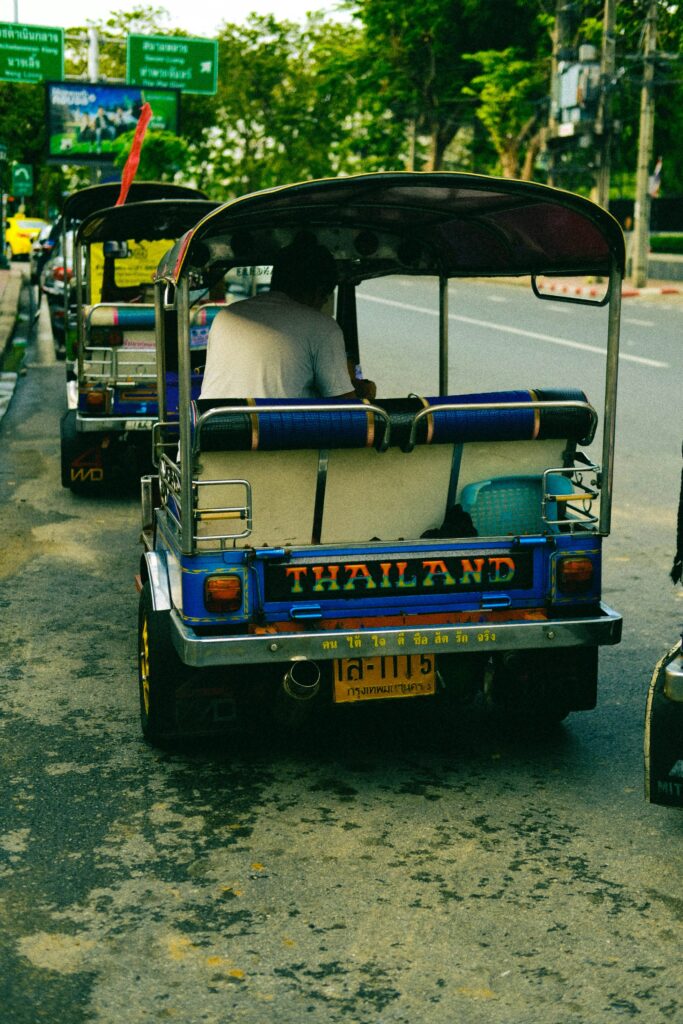
The Great Krabi Slip-n-Slide
One second I was strolling.
The next, I was surfing against my will.
The floodwater grabbed my legs and started carrying me downhill like a human paddle-pop stick. I fell backwards, arms flailing, dignity abandoned. Motorbike horns blared. Tuk-tuks splashed past. Up above, tourists filmed me for their Instagram stories under captions like “When your chakras are misaligned 😂”.
I was genuinely in trouble. The water was faster than it looked. I was being funnelled toward a culvert—a low, wide storm drain that I absolutely did not want to explore without a guide, a headlamp, and perhaps a priest.
I dug my heels in. No use.
I grabbed a lamp post. Slippery as a politician’s promise.
I tried breaststroking against the current. Impossible.
That’s when it happened.
My left thong popped off.
I watched it bob away, twirling heroically. I thought it was gone forever. But then it jammed, perfectly, miraculously, between two metal grates at the culvert’s entrance.
The thong wedged itself so firmly that the water flow split—rushing around it like it had encountered a small but extremely Australian dam. It disrupted the current just enough that I could grab the culvert edge, haul myself sideways, and scramble up onto a nearby tuk-tuk bonnet.
I lay there, gasping, soaked, and alive.
My thong—the humble, tattered, $4 double-plugger—had sacrificed itself to save me.
Somewhere, in the distance, I swear I heard a kookaburra laugh approvingly.
Aftermath of a Hero
As I regained my composure (and checked whether anyone had filmed me—of course they had), a local vendor approached with an umbrella.
“You very lucky,” she said, staring at the culvert.
“Yeah,” I replied. “My thong saved me.”
She blinked.
I realised she thought I meant the other kind of thong.
I attempted an explanation. It did not help.
But something deeper stirred in me as I collected the lone surviving thong from the street and looked back at the heroic one still wedged in the grate. I considered retrieving it, but some sacrifices must be honoured. Like every good war hero, it deserved a memorial. I left it where it stood—firm, brave, and unquestionably stuck.
Later, at my hostel, a Canadian backpacker asked why I walked into the common room with only one shoe.
“It’s not a shoe,” I corrected softly. “It’s a story.”
A Study in Aussie Resilience (According to People Who Didn’t Mean It This Way)
In the days that followed, I reflected on my near-death experience through the lens of what several authorities have accidentally taught me:
- According to the Australian Psychological Society, familiarity with comforting objects during stress can reduce panic responses. Hence: thongs = emotional support footwear.
- The University of Queensland School of Engineering once released a paper on fluid dynamics that explained how small obstacles can significantly reduce water velocity in narrow channels. My thong literally executed a hydrodynamic manoeuvre.
- A Tourism Australia brochure claimed Australians are “natural problem solvers with a spirit of improvisation.” They weren’t talking about footwear, but they might as well have been.
These weren’t just academic references—they were confirmation that the thong is more than a strip of rubber. It’s an artefact. A philosophy. A lifestyle.
Ode to a Fallen Friend
Back home in Sydney months later, I sometimes found myself thinking of that lost thong. I imagined it still there, wedged proudly in that grate in Krabi, performing ongoing community service—diverting rubbish, slowing water flow, occasionally confusing curious crabs.
I bought new thongs of course, but it wasn’t the same. They didn’t have the same grit. The same loyalty. The same hydrodynamic instinct.
Sometimes I consider returning to Thailand to check on it. Maybe lay a wreath. Perhaps nominate it for some form of civic recognition. The Royal Australian Mint once released commemorative coins honouring the pavlova and the meat pie—surely a thong of valour deserves at least a limited-edition stamp.
In Conclusion: Never Underestimate a Thong
People travel to discover themselves, broaden their horizons, or eat their body weight in mango sticky rice. But every Australian learns sooner or later that travel is also about discovering the hidden power of the things we take for granted.
Like sunscreen.
Or Aeroguard.
Or that one tatty pair of thongs you keep for camping, gardening, and confronting snakes.
Myth? Maybe.
Miracle? Possibly.
Scientifically endorsed hero? According to the creatively interpreted findings of several respected institutions—absolutely.
So next time you slip on your double-pluggers before catching a flight, remember this:
They may just be rubber.
But under the right circumstances, they’re armour.
They’re wisdom.
They’re fate.
And occasionally—when the monsoon hits—they’re a lifesaver.